


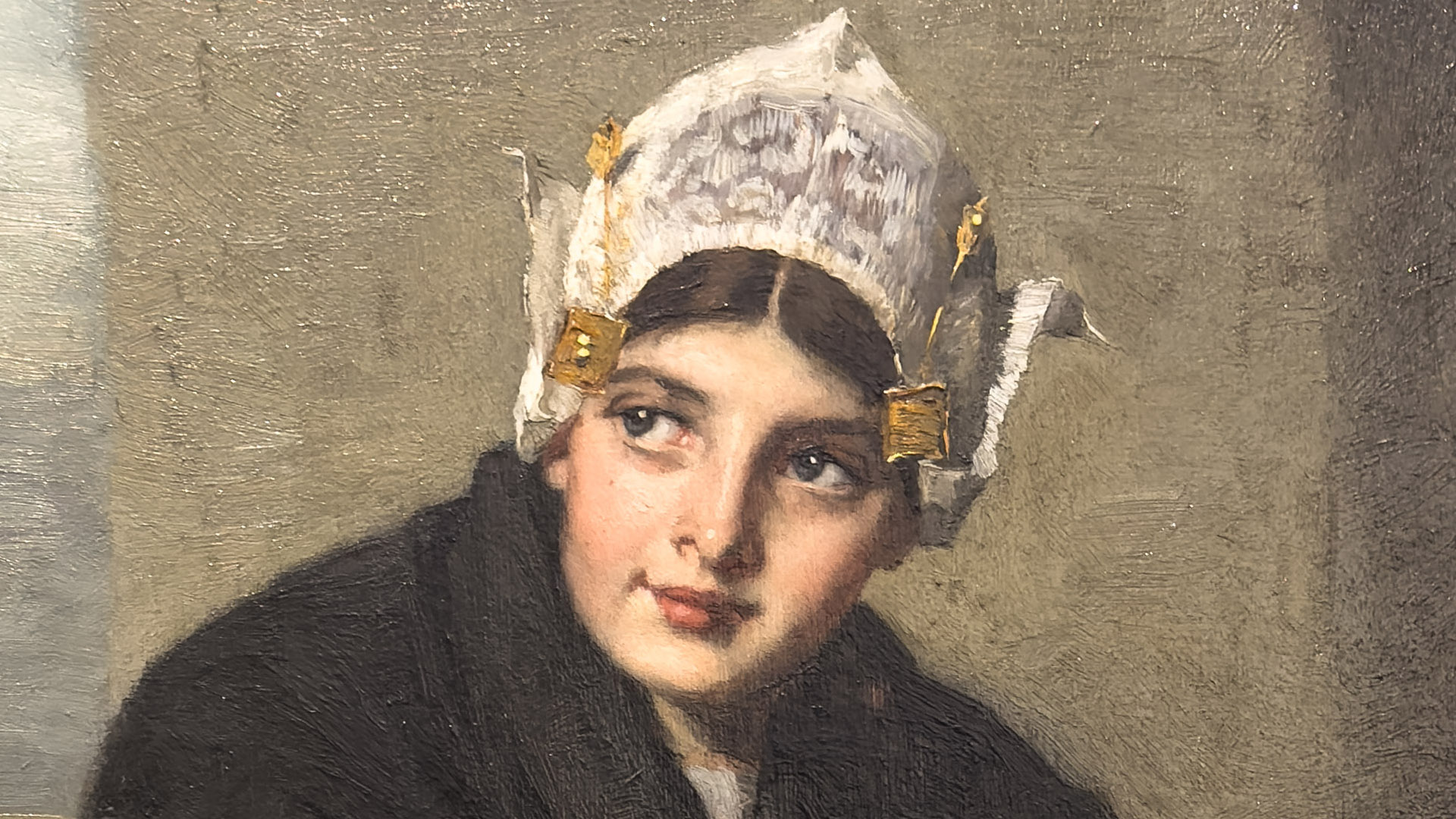

The painting “Zandvoort Woman” (1884) from the collection of the Zandvoorts Museum is a beautiful example of a lesser-known but crucial phase in the career of Thérèse Schwartze. While she later became world-famous for her glamorous portraits of the elite, this work demonstrates her talent for capturing “ordinary” life with immense technical depth. It is a powerful portrait of a fisherwoman. A pink (fishing boat) is visible in the background. The woman, dressed in traditional costume, holds a basket of fish.

In the 1880s, the period in which she also painted Three Girls from the Amsterdam Burgerweeshuis (1885), Schwartze experimented extensively with realistic genre pieces. The Zandvoort Woman fits into the tradition of artists who traveled to the coast to capture the local population in traditional dress. Although she was influenced by the Hague School, Schwartze gave it her own twist: less somber and with a sharper eye for detail. Note how she renders the different textures of the clothing. The stiff fabric of the skirt and the delicacy of the cap demonstrate her technical superiority. Although it is a modest subject, she treats the woman’s face with the same respect and refinement as that of a queen. The light falls in a way that emphasizes both the hardship of the fishing life and human dignity.
Schwartze was praised for bringing her models to “life” on the canvas. In the Zandvoort Woman, you see a powerful, characterful gaze. It is not a romantic or sentimental image of a fisherwoman, but a portrait of an individual with her own story. This ability to capture character was precisely the reason why the nobility later queued up for her.

Sketches by Schwartze from the same period can be found in the collection of the Rijksmuseum. There is a sketch of hands in which the sketch of the hand on the right is almost identical to that in the painting. On the right, a sketch of a seated woman is visible. It could be the same model as the Zandvoort Woman.
In 1884, the more fluid brushwork that Schwartze had picked up in Paris was already visible. Instead of meticulously detailing every element (as her father had taught her), she dared to use large, confident strokes in the background and clothing. This gave the work a freshness and modernity that was highly innovative in the Netherlands at the time.
It reminds us that Thérèse Schwartze was not only the painter of the wealthy, but an artist who could capture the essence of a person, regardless of their social status. It forms the perfect bridge between her early realistic years and her later international stardom.
The Zandvoorts Museum displays this work as one of the highlights in their permanent presentation ‘The Life of Memories’, where it connects art history with the local history of the village.

Thérèse Schwartze (1851–1918) was one of the most successful and influential Dutch portrait painters of the late 19th and early 20th centuries. In a time when the art world was primarily dominated by men, she managed to build an international reputation as the pre-eminent portraitist of the Dutch and European elite. Her work is characterized by a rare combination of technical virtuosity, commercial insight, and a glamorous style.