


Karl Friedrich “Fritz” Mock was born on September 13, 1867, in Böblingen, in the German state of Baden-Württemberg. He developed into a versatile artist with a German-Swiss background, who was primarily active in Switzerland around 1900. His life and work were largely centered in Basel, where he passed away on September 30, 1919.


Mock did not begin his career as a painter, but as a lithographer. This graphic foundation would later prove to be a major influence on his work. In 1885, he left for Munich to pursue an education in painting. There, he received a thorough academic training that provided him with technical stability and enabled him to move freely between different disciplines. In 1893, he moved to Solothurn; later, he settled permanently in Basel. He was active there not only as an artist but also as a teacher. Notably, he founded his own painting school for women—a progressive initiative at a time when art education for women was not yet a given.

In the first phase of his career, the emphasis was on painting. Mock worked extensively in watercolor and developed an Impressionist style with a refined treatment of light and color. His work often depicts landscapes and everyday scenes, in which atmosphere and the moment are more important than detail. He exhibited with the Schweizerischer Kunstverein, among others, gaining a certain degree of recognition within the Swiss art world.

Later, his focus shifted increasingly toward the graphic arts. Here, his technical versatility fully blossomed. Mock worked with woodcut, lithography, and linocut, mastering these techniques with great precision. Approximately one hundred ex-libris—small, artistic bookplates—bear witness to his craftsmanship. He often designed these in an elegant Art Nouveau style reminiscent of the work of his contemporary Alphonse Mucha. The portfolio Fritz Mock Gelegenheitsgraphik contains signed ex-libris, including a personal copy featuring his address: Theodor Strasse 2 in Basel. On this print, he depicted himself as a satyr with a violin, drawing portfolios under his arm, a painter’s box in hand, and a parasol. It is a playful self-portrait that shows Mock was not only a painter and graphic artist, but also a musician. Among the ex-libris is also a copy belonging to his wife, Milly Mock-Oelhafen, on which she is seen sketching an Alpine landscape. In addition to his graphic work, Mock also produced illustrations for books.

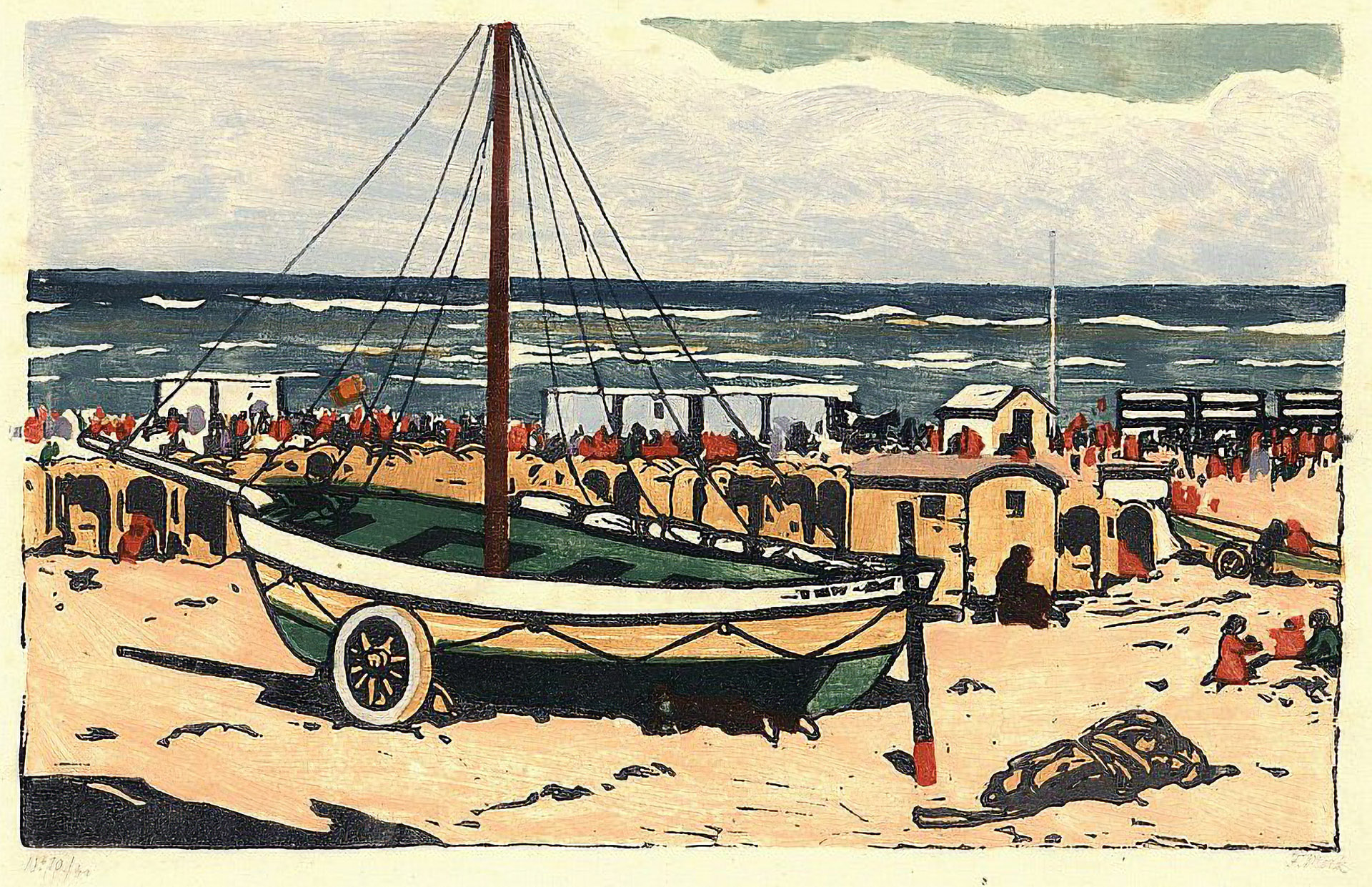
Around 1913, Mock spent some time in the Netherlands. Watercolors of women in traditional costume are known from this period, presumably painted in Marken. In that same year, he visited Zandvoort, where he created the watercolor Strand Zandvoort (Zandvoort Beach). This work was purchased by the Zandvoorts Museum on February 6 and will be on display for a year in 2026 as part of the presentation In the Spotlights.

Mock also produced a multi-colored woodcut of the same scene, in which the children in the foreground are omitted.
Mock’s Dutch period aligns perfectly with his enduring interest in modern daily life and in landscapes where people and their surroundings converge. He convincingly united painting and printmaking, remaining a representative figure of art at the turn of the century—an artist who moved effortlessly between the easel and the printing press.