


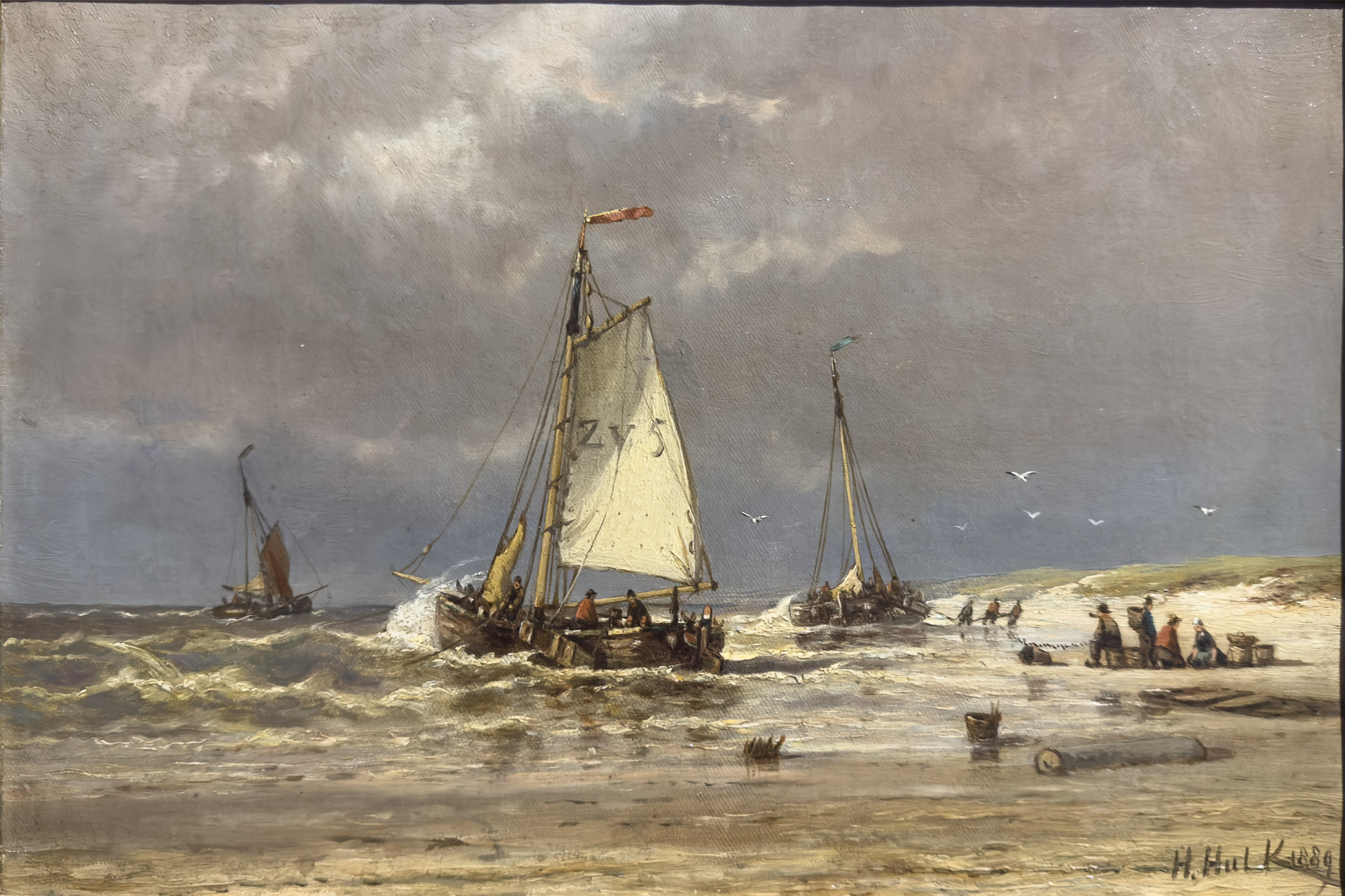
In 1889, Hendrik Hulk painted the arrival of the last three Zandvoort fishing boats that were still in operation at the time. The scene marks the end of a centuries-old tradition, as fishing in Zandvoort came to a definitive halt around 1900. Most fishermen moved to IJmuiden to continue their trade there, while others sought their future in the rapidly emerging tourism industry.
That is precisely why this painting is of special historical significance. It captures one of the final moments of Zandvoort’s fishing industry and offers a unique snapshot of a profession and a village culture that would disappear forever shortly thereafter.

Hendrik Hulk was born in Amsterdam on May 12, 1842, the son of the marine painter Abraham Hulk, from whom he also received his first painting lessons. After spending his youth in Enkhuizen, he settled in Haarlem, where he lived and worked for most of his life. He developed into a versatile artist, but became best known for his atmospheric seascapes, river views, and harbor scenes, as well as beach scenes along the Dutch coast.
Hulk worked in a realistic style, paying close attention to the changing light, the water, and daily life on and around the coast. His subjects included the Zuiderzee, the Spaarne River, the port of IJmuiden, and the beaches of Zandvoort and Katwijk. His work was regularly exhibited in cities such as Amsterdam, The Hague, Arnhem, and Rotterdam, and was also sought after by international collectors.